What Do These Stones Mean?
“When your children ask their fathers in time to come, saying, ‘What do these stones mean?’ then you shall let your children know, saying, ‘Israel crossed over this Jordan on dry land.’”
— Joshua 4:21–22
There are places that become more than places.
A building can become a landmark. A bell can become a familiar sound. A steeple can become part of the landscape. But sometimes these things become something even more important: they become reminders of what God has done.
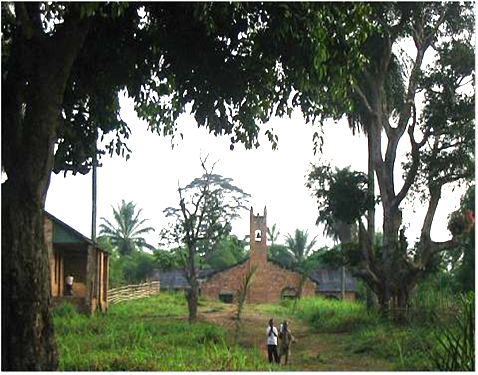
Today, when we look at the historic church at Ndjoko Punda, there are visible reminders of that long story.
The steeple rises above the church with a bell. I remember as child listening to the bell as it called people to worship. The bell also rang daily during the week to let people know what time of day it was.
Jim Bertsche in his history of Congo Inland Mission shares the story of the church bell ringing several weeks after the missionaries had evacuated in 1960. As the bell was tolling several Congolese came to the entrance and challenged the bell ringer, “What’s the matter with you? Are you crazy? Why do you ring the bell these days? Who has time to listen or to come? Even the missionaries are gone.” The man pulling the rope paused for a moment, then asked: ‘And has God gone too?’ With that he gripped the rope firmly and once again bent his back to his task. The bell continued to send its message of rebuke and remembrance across the station and to the surrounding populace.”
In 1912, the Congo Inland Mission established a mission station at Ndjoko Punda in what is now the Democratic Republic of Congo.
At the time, there was no way to know what God would do through the small beginning that was established there. Missionaries came to a remote part of the Congo with a desire to share the Gospel, teach the Scriptures, and establish a Christian witness among the people.
Three years later, in 1915, the first two converts were baptized. Two people. It would have been easy to look at that small beginning and wonder what lasting impact could possibly come from it. But God often works through beginnings that appear small. Those first baptisms were not simply an event recorded in a mission history. They were the beginning of a story that would continue through generations. They could not see the children who would grow up hearing the Gospel. They could not see the pastors and teachers who would later serve the church. They could not see the generations of believers who would worship Christ in that place.
For more than a century, this place has been connected with the proclamation of the Gospel. Generations of believers have worshiped, learned, prayed, served, and raised their families there.
The physical reminders of that history matter because they help us remember the people and events that came before us—and, ultimately, the faithfulness of God.
The story of Ndjoko Punda is therefore not simply a story about a mission station established in 1912. It is a story about a Gospel witness that has continued for more than a century.
The church we see today did not begin today. It has roots. It has a history. It has a testimony. And that testimony reaches back to those early missionaries who stepped into an uncertain future with the conviction that the Gospel was worth proclaiming.
The Bible repeatedly calls God’s people to remember. The question is not simply: “What happened here?” The deeper question is: “What has God done here?”
Our desire is that future generations will have a visual reminder and ask: “What do these stones mean?”
And someone will tell them about generations of Christians who worshiped Christ in that place. They will tell them about the prayers that were prayed, the Scriptures that were taught, the lives that were changed, and the faith that was passed from one generation to another. And perhaps most importantly, they will tell them: “This is what God has done.”
That is why Hope for Congo continues to invest in the community of Ndjoko Punda. We remember what God has done and we want future generations to remember. Because remembering the past is not about living in the past. It is about recognizing God’s faithfulness—and carrying that testimony into the future. The story of Ndjoko Punda is a story worth remembering.
The question I ask myself and I am asking you is: “What stones can we leave behind as a memorial to God’s faithful witness of His Grace and Love”?
Hope for Congo is making plans to build a new church building at Ndjoko Punda. We recently received a gift of $20,000 towards the launch of this project and we invite you to become part of this adventure through your prayers and financial support. Be watching for more information and plans to follow over the next several weeks.

