We’re glad you joined us today for Part 2 of the recent activity at Mangungu carried out by David, Bud, Nelson, and Mark. This letter was written by Clement (Bud) Kroeker. Read Part 1 of Bud’s letter at this link.
Part 2
It was quite a challenge for David to organize the various crews of workers–the men from Matende as well as the volunteers from Mangungu. He gave responsibilities to some of the men who worked with him the past three trips and let them supervise the different construction sites. But he faced the problem of having too many volunteers, not enough tools, and not enough supervisors. So we decided to use one group to work on the stone house and another in the Health Center.
Three ladders (built on previous trips) came with us on the truck. Two others needed to be built plus the scaffolding. A crew of young men started digging the cistern for water. Another crew started digging a hole for the septic tank.
The shovels (made in China) that we had purchased in Kikwit were not sturdy enough and soon the handles were breaking one by one. But in true Congolese fashion, the men would quickly replace the handles with sturdy wooden branches or poles they cut down with their machetes to fit.
The electrical generator was installed under the huge mango tree and this was the wood-working shop. I found an old piece of concrete broken off of an ancient bath tub made by some missionary sixty years ago. This served as a chair for me. It became my director’s office. However, I didn’t spend much time there because bits of stone and concrete flew in every direction as the young men tried to straighten up the old walls and pour concrete on top of the door posts and windows to give added strength.
Nelson brought up sand from a spot near the river. It was very hard to drive down there with the truck in order to bring water. So we asked the children to each haul a quart of water on their heads when they come up in the morning. Gravel will probably have to be hauled up in the same way by the older fellows.
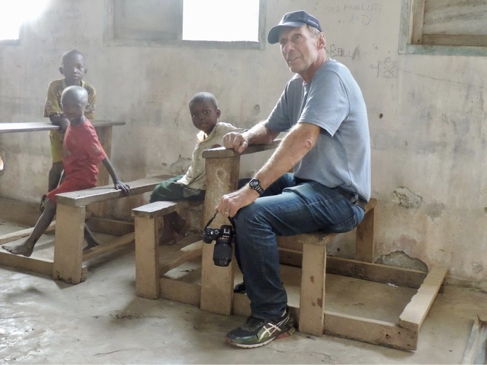
Mark with children at Matende
After the first day’s work we already saw the progress made: two huge holes dug, each around 6 feet in depth; half of the old tin roofing panels were taken off the Health Center and the walls were strengthened with concrete in the cracks, after putting in solid iron bars.
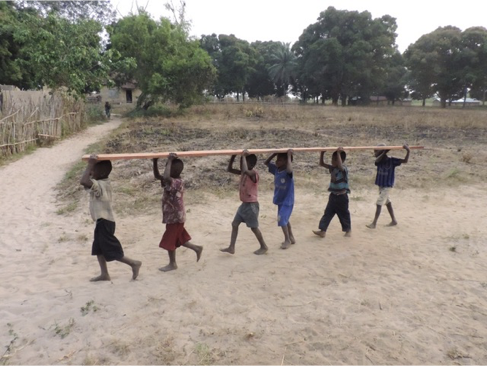
In the evening a parade passed by our house, everyone carried a board to take the entire stack of boards over to the school area where they would be protected. The big men each carried one board, the younger men each took one end of a board, and the children (sometimes as many as six under one board), carried it on their heads!
I had only a limited stock of Bibles with me on this trip, 50 in French and 50 in Kikongo — but I gave one copy to each pastor in the villages surrounding Mangungu. Everyone gathered under the mango tree for a meeting of gratitude, to sing and pray and express their thanks to God.
Our hearts were blessed to be able to live these moments of true worship and praise. If we didn’t accomplish anything else on this trip, it was worth the time and effort spent, just to have been in that meeting with others of God’s children!
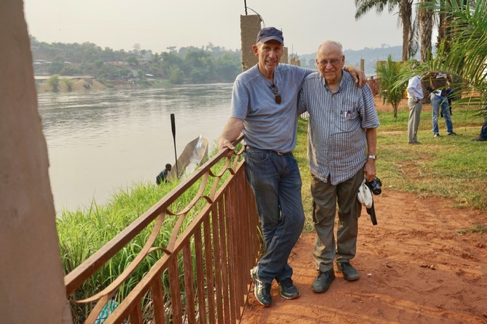
Kikwit by the Kwilu River
Psalm 67 May God be gracious to us, and bless us
and make his face shine upon us; so that your ways may be known on earth,
your salvation among all nations. May the peoples praise you, O God;
may all the peoples praise you. May the nations be glad and sing for joy…
(verses 1 – 4)
With grateful hearts for your prayers for us in Congo,
Bud, Mark, David and Nelson
_________________________
What a joy it is to see the Congolese teamwork to accomplish a goal for the common good. If you wish to know more about Clement (Bud) Kroeker’s work visit his website: http://congoopenheart.org/projects/
The following post is taken from a letter regarding recent repair activity at Mangungu. Four men made a trek there this summer. Part 1 of the letter from Clement (Bud) Kroeker follows:
July 12, 2017
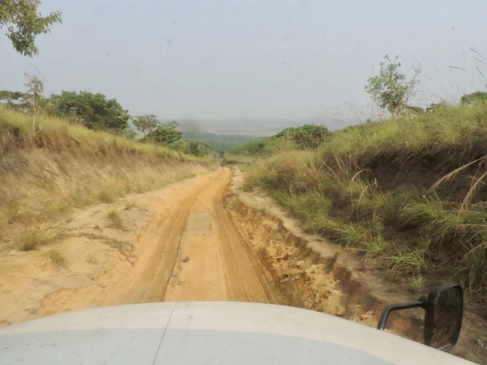
Dear Friends, First day in Mangungu. Our trip here took 5 hours with a one hour stop because of rain. Mangungu covers a vast area and the road coming in is barely visible among the tall grass and trees.
When we arrived in the evening, we were welcomed by a huge crowd of children singing and calling welcome. By then it was dark, but all the folks gathered for a big welcoming ceremony. The Pastor Mushifele Degaule had emptied his house to let us use it for our living quarters. But in the black of the night, inside and outside of the house, it’s very difficult to find anything at all. We just had to wait until the cock started crowing about 4:00 a.m. to have the light of day. People began strolling by to visit us at 5:00 a.m. and there was a constant gathering around our house all the time!
David, Bud, Nelson & Mark at Brussels Airport
Women cooked on an open fire outdoors in a tiny hut at the side of our house to provide us with meals. They cut the wood, boiled the water, and did everything from scratch. Down on the other side, the chickens walked around our court yard, looking for crumbs falling from our table or drinking the water from the basin on the ground where we washed our hands.
We started the day with a guided tour around the mission. The Pastor, our tour guide, explained each thing. The men who came with us from Matende were very astonished and touched to see the sad state of the buildings here. They didn’t realize it was so bad.
The Health Center is in ruins and can no longer even be called a Health Center. The Secondary School, which used to be a Bible Institute, has had a few tin roof panels stuck on, but the entire roof is open to the sky. The Church building consists of a few adobe bricks still standing that haven’t given in to the rain.
Finally we walked by the stone house we had come to rescue. After 60 years without a roof, the walls are still in better condition than all the other former buildings, at least they have fewer cracks in the walls. The folks here at Mangungu have emptied out all the trees and grass growing inside and around this stone house.
__________________
Join us next week for part 2 of their adventure. All repairs in Congo are an adventure in ingenuity.
DR Congo Kasai violence displaces 850,000 children
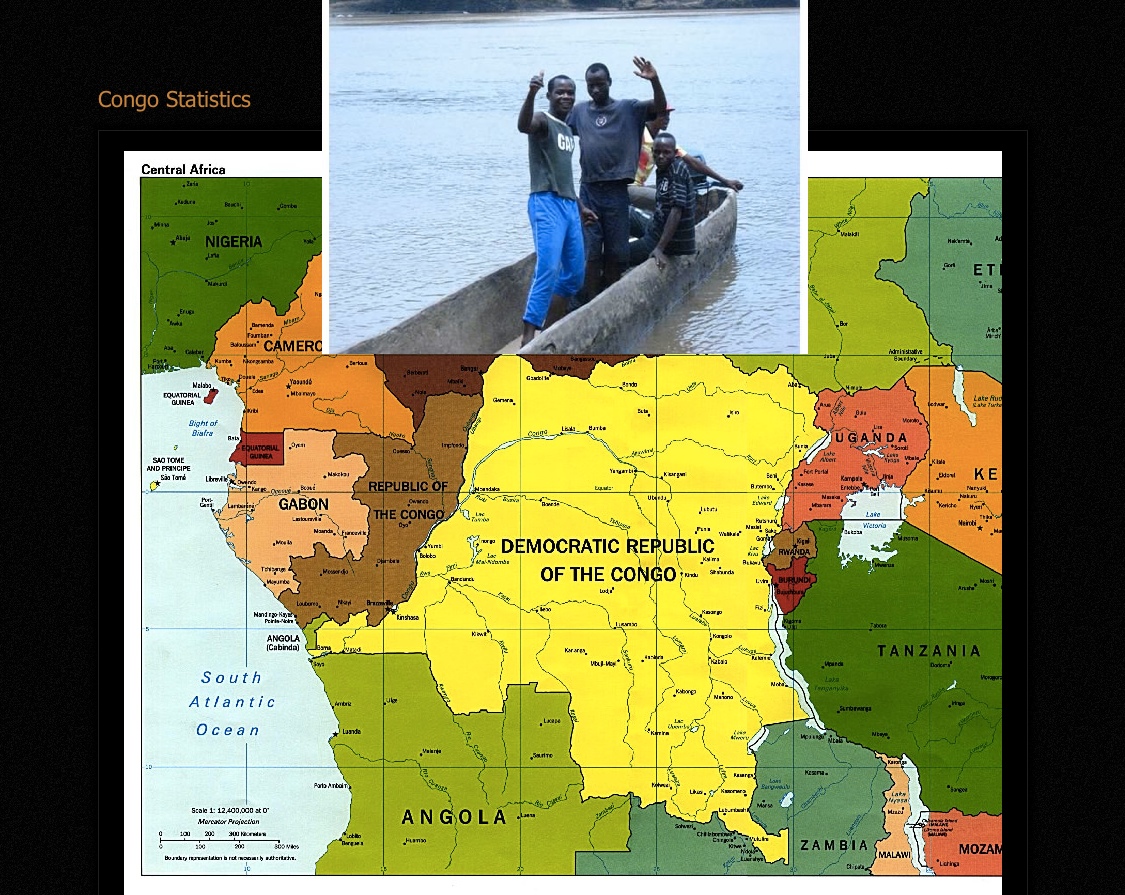
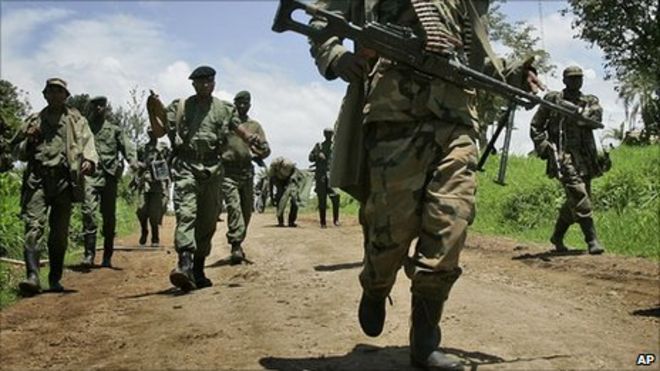
An estimated 850,000 children have been forced to flee fighting in the Democratic Republic of Congo’s Kasai provinces, the UN’s children’s agency Unicef reported in July.
This makes it one of the world’s “largest displacement crises” for children.
Many of the affected children are now in foster care or with relatives.
Fighting broke out in Kasai in August 2016 after a traditional leader was killed in clashes with security forces.
It has since escalated leaving more than 3,000 people dead. The UN has also discovered dozens of mass graves in the area.
In all, 1.4 million people have had to leave their homes “with 60,000 uprooted in June alone,” says Unicef’s acting head in DR Congo Tajudeen Oyewale.
____________________
This area is in the heart of where Hope4Congo focuses our work.
Prayer Requests: • Please pray for an end to the violence in DRC • Please pray for these precious children • Please pray for the needs (physical, spiritual, emotional) of all Congolese
Someone has asked me to explain what I mean when I use the phrase, Put your yes on the table and let God put it on the map.
I first heard the phrase from Ed Stetzer, Executive Director for the Billy Graham center in Wheaton. I am not sure where it originated. However, it has stuck with me because I think it encapsulates the essence of discipleship. Let me explain.
What Table? The term table is designed to conjure in one’s mind the idea of a conference table. It refers to a place where ideas are discussed, challenges presented, and decisions made. When something is on the table, it’s an option, an opportunity, something that could be negotiated. However, one has not said, yes or no to an offer yet.
What does Put (it) on the Table mean? To put (something) on the table means it is on display for everyone to see. It is the opposite of under the table, which usually refers to something that is covert or unlawful.
What does my Yes on the Table say? It says, “You can count me in.” Or, “I’m in agreement. I’m ready for the challenge, ready to take the risk and ready to participate.”
Typically we like to be sure of something before we do it. We want to know ahead of time what to expect. After all, isn’t good planning prudent? We want to make our plans and decide instead of agreeing to whatever.
However, sometimes God calls us to obey without giving us all the details. Sometimes He asks us to agree with Him before we know His whole plan. That can be quite unsettling for sure.
Then how do we: Let God Put it On the Map? Mother Teresa is a good example. At the age of eighteen, she said, “Yes,” and allowed God to put it on the map. Her yes is reflected in a prayer request she sent to a spiritual confidant:
“(Pray) that I let Him (God) have a free hand.”
Thus began Mother Teresa’s journey. Eventually God led her to Calcutta, India where she gave wholehearted free service to the poorest of the poor.
Are we confident in God? Can we trust Him to orchestrate everything toward something good, beautiful, and beyond what we could ever ask or imagine? The ultimate yes, is committing to God without knowing the specifics, without knowing what He will ask of us.
So what is the Map? A map speaks of location. However, it can also refer to clarity, direction, arrangement, order, or assignment.
With God we may not always be able to make out the plan or make sense of the plan, but we can trust Him. Why? God delights in the details of our lives. God has promised, “I will never leave you or forsake you.”
My brother and I have said yes to God without knowing where it will finally take us. Hope for Congo was born out of our yes. I don’t know what God has in mind. I don’t know how He wants to use our commitment to shape our lives and the lives of others, but I do know that the outcome of this journey is totally in His hands.
I invite you to . . . Put your yes on the table and let God put it on the map.
When you do . . . things will happen.
It’s an exciting and fulfilling way to live.
__________________________
Thank you for the challenge, Brad.
News from Congo: The tribal conflict has claimed more lives. The enemy of our souls is at work.
Charles Buller reported: “Please pray for Adolphine, a dear sister who I got to know well during my last trip to Congo. She serves as the ‘Mama Presidente’ of women for the CMCo family of churches, and attended the AIMM-sponsored literacy training at the same time that I was in Kinshasa this past April. Adolphine, whose husband passed away some time ago, has since been supported in part by her younger brother who has managed a small farm in a village called Inga some 40 miles from Tshikapa. Adophine just found out that her brother, his wife and children, along with other family members were all slaughtered – caught in the tribal conflict going on in the Kasai Region. When I called her yesterday, we ended up weeping together over the phone for nearly an hour. She is broken to the core.”
Prayer Requests: • Please pray against the evil and for an end to the deceptions, which lead to violence. • Please pray for God to raise up wise and godly leaders who find favor in the eyes of all Congolese. • Please pray for the people to receive Christ’s grace and strength to forgive.
Leja Bulela means “show that you care” in the Tshiluba language of the Luba people.
Hope for Congo attended and participated in the 2017 Annual Conference for Leja Bulela in Washington D.C. The theme of the conference was “Congo-Unlimited Possibilities, Unlimited Potential.” Leja Bulela members are part of the larger burgeoning Congolese ex-patriot community in the United States and Canada.
Leja Bulela was founded in 1993 as a reaction to the expulsion of an estimated 500,000 Kasai natives from the Katanga province of the Democratic Republic of Congo in the early 90s. What began as a response to a refugee need exists today “to improve the lives of our brothers and sisters living in Kasai, specifically those in Tshibombo Tshimuangi.”
A key initiative has been the building, funding, and managing of a medical clinic, which serves a population of 80,000. Tshibombo Tshimuangi is about a 45-minute drive from Mbuji Mayi, which serves as the capital city of Kasai Oriental province.
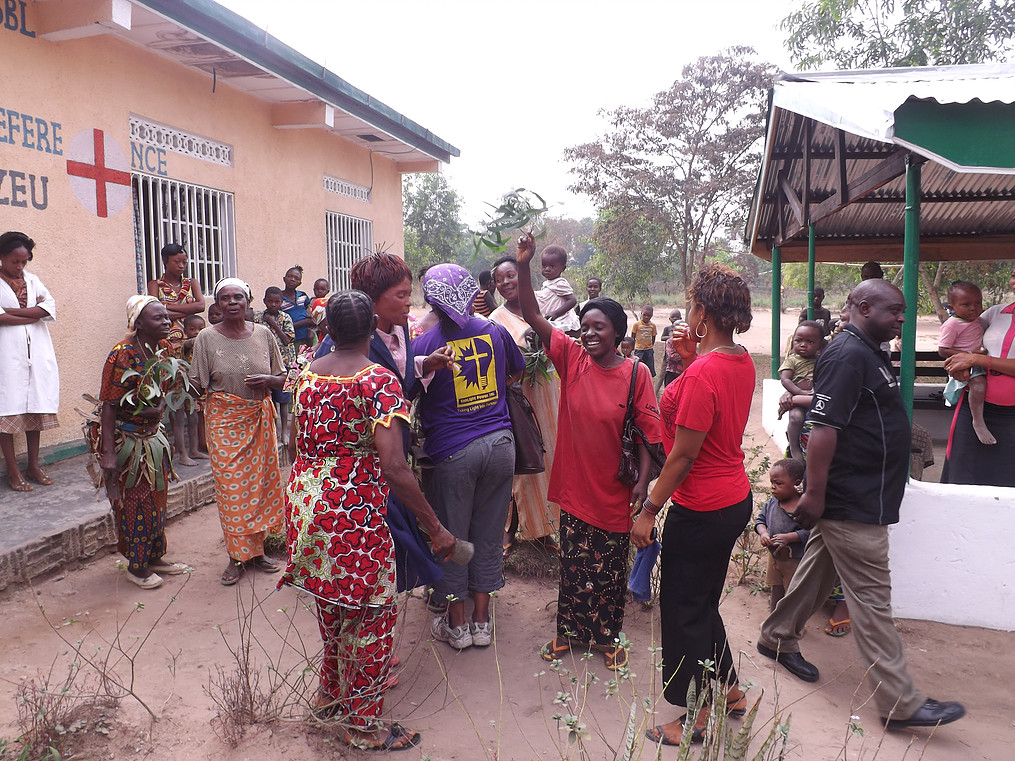
Leja Bulela opened the Kalala Muzeu Health Clinic in 2011 with the goal that it would eventually be self-sustaining. Leja Bulela members donate monthly to maintain the upkeep costs and employee salaries.
Topics discussed at the conference included: • Best practices for managing a health facility • Impact of primary health care strategies and initiatives • Leveraging the power of water • Using technology to build community
Hope for Congo was impressed with their passion, commitment, and engagement in the East Kasai. It is a witness to their love and care for their brothers and sisters in Congo.
The needs in the Democratic Republic of Congo are great. The complexities do not allow for simple short term solutions. Leja Bulela is entering its 25th year of direct involvement and personal commitment to a long term goal.
Hope for Congo is encouraged by the efforts of Leja Bulela and realize the complexities in Congo can only be addressed through an array of organizations collaborating together with a common over-arching purpose, to improve the lives of our brothers and sisters living in Congo.
Hope for Congo has been blessed by the collaborative and generous donations that our supporters have and continue to make. We are grateful and humbled. The collaboration of giving and doing, generosity and action, praying and keeping in step with God will continue to improve the lives of our brothers and sisters in Congo. Let’s put our “YES” on the table and let God put it on the map.
Leja Bulela!!! Show that you care!!! _______________________________________________
Thank you, Brad for letting us know about another organization formed to help our brothers and sisters in Congo.
Please continue to pray for peace in Congo and wisdom for all parties to maintain it.




 Hope 4 Congo
You must be logged in to post a comment.