Before the Throne, Part 1

After this I looked, and there before me was a great multitude that no one could count, from every nation, tribe, people and language, standing before the throne and before the Lamb. They were wearing white robes and were holding palm branches in their hands.
Revelation 7:9

_____________________________

A few weeks ago we shared the dramatic story of Pastor Wayindama. You may remember the wisdom he displayed as he was able to intervene for the safety of the missionaries and of the seminary students during the political unrest of 1962. If you have not read that story yet, please feel free to click on the link provided on his name.

We would like to honor Wayindama further. So today we’ll share a brief summary of the rest of his story.

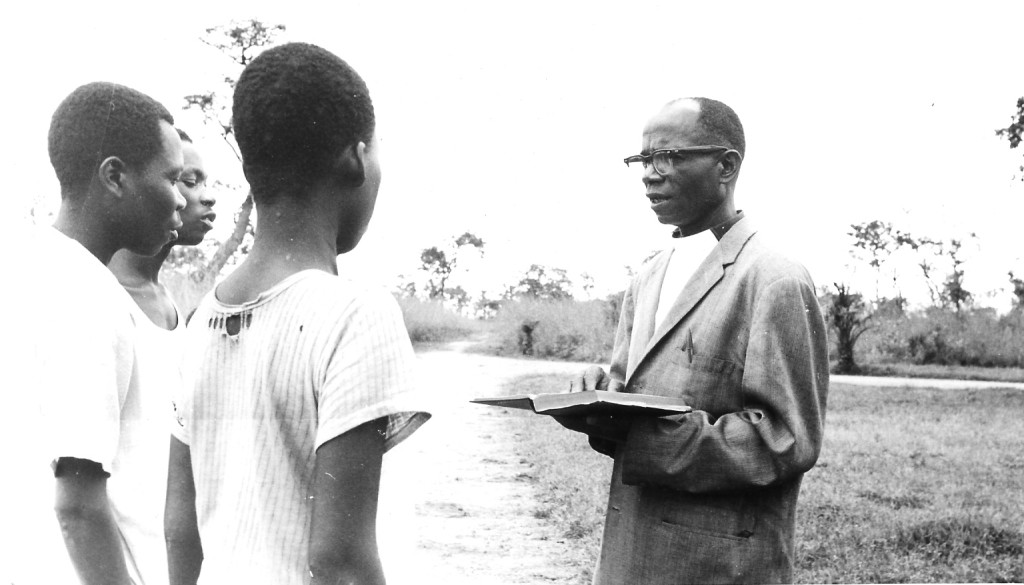
First it must be noted that Wayindama was identified as a very gifted and wise young man. He was appointed as a teacher in Mutalawanga and later in Kamayala. Through a competition he was selected as one of the best candidates to continue his studies at the Kalonda Bible Institute, where he later became a professor.

At that time (1940-50s) many Congolese with limited Biblical training became pastors based on the missionaries’ esteem and recommendation. Wayindama was the first pastor in the territory of Kahemba with extensive Biblical training. Missionary witnesses believe it was his solid training that contributed greatly to the growth of his strong and peaceful personality.

Wayindama contributed to the translation of the Bible into local languages, specifically he was part of the translation team of the Chokwe Bible. Preaching in the local trade language was not enough. He believed Christians needed to read the Bible in their native tongue, which would allow them to meditate on the word of God in their heart language. This in turn would help strengthen and deepen their faith.

Christianity should belong to each community.
It should not be a foreign object if it is to take root
in the culture, morals, and ideas of the people.

Witnesses reported Wayindama went anywhere the church needed him. He put himself completely at the service of his fellows. The local church in Kandala gave him credit as the pioneer of the orientation course at the missionary station. In his leadership role he also inspired many young leaders.

During Wayindama’s lifetime, the church did not pay much attention to the material needs of the Congolese men and women who responded to the call of Christ. These dear ones often served at the peril of their health, because they lacked transportation.

Because Pastor Wayindama belonged to the class of the wise, he was called on repeatedly to settle or arbitrate conflicts. He traveled great distances on bicycle or on foot.

In spite of his difficulties, he did not become discouraged. In all his prayers he repeated in song, “Lord, it’s you whom I ask for strength.”

In 1991 Wayindama died at age sixty-five. Pastor Athanase Musende was one of those who sat beside him in the last moments before his death. Musende and the other witnesses affirmed they had witnessed the death of a pious man.

Surely Wayindama will be one of the multitude standing before the throne.
____________________________

We at Hope4Congo agree with Wayindama. Bibles need to be translated into the heart language of the people/their tribal languages. It is why we focus so much of our work on this effort: the Bible Project.

If we are able to put God’s Word into their hands,
God will put it into their hearts.

Feel free to also read these two blog posts about this work: New Bible Translation and Bible Distribution Project.

If you follow our blog regularly, you also know, with your help we were recently able to make it easier for one pastor/evangelist to fulfill his role through the purchase of a motorcycle: Meet Saraphin Kutumbana.

If you would like to contribute to the work, please utilize the information below:

Donations are tax-deductible. We’re all volunteers here at Hope 4 Congo. No one receives any compensation. Make your checks payable to: AIMM or Africa Inter-Mennonite Mission

Designate your donation to: Hope 4 Congo and indicate which project you wish to support
Example: “I would like this donation to be given to Hope 4 Congo for the Bible project.”
Check our PROJECTS page for additional suggestions.

Send your tax-deductible U.S. Dollar Donations to:
Africa Inter-Mennonite Mission (AIMM)
P.O. Box 744
Goshen, IN 46527-0744

Send your tax-deductible Canadian Dollar Donations to:
Africa Inter-Mennonite Mission (AIMM)
440 Main Street
Steinbach, MB R5G 1Z5

Our thanks to author, Vincent Ndandula; and to the Institute of Mennonite Studies (copyright 2012) and to the Institute for the Study of Global Anabaptism for the information we have shared about Wayindama’s life.

Please join us February 22 when we will share the story of Rev. Athanase Musende.

© 2018 Hope4Congo
Meet Saraphin Kutumbana


by Stan Graber

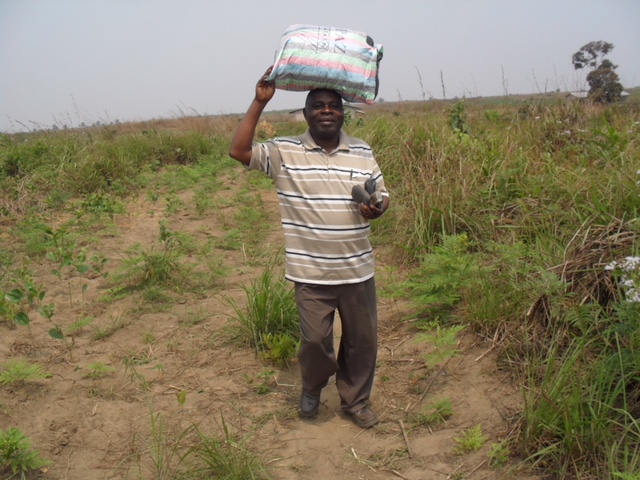
My friend, Kutumbana is a one-in-a-million evangelist in Congo. He and his wife live in the capital city of Kinshasa. However, as head of a three-man team, he regularly travels on foot or by bicycle to the Bateke Plateau outside Kinshasa. His team seeks to evangelize a tribe called the Bateke.

A few years ago the team visited a certain Muslim village. One man who heard the Gospel decided to accept Jesus as his Savior. Two weeks later when the team returned to disciple this man, he had changed his name from Hibrahim to Jeremie.

“I have come out of the darkness into the light!” Jeremie said.

Jeremie’s testimony was so strong that his former Muslim friends beat him up. His injuries required medical treatment in Kinshasa for well over $100. This may sound like a small amount to us, but we need to remember the poverty level of Congo.

The Muslim villagers burnt his house down, destroyed his fields, etc. But his testimony remained so great that six months later he was able to bring out nine more men (with their families) including his uncle!

A year later, Jeremie decided to move back to the village where he grew up and start a church. Recently, he contracted Malaria and died, but his testimony continues.

What began with a handful of Believers has expanded to twenty Christians. Kutumbana attended Jeremie’s funeral service along with forty-five men, women, and children. Even more folks continue to accept Christ—all because of the witness of Jeremie!

So the ministry of Kutumbana and his team has born good fruit—fruit that remains.

Kutumbana’s monthly salary of $75 from the Mennonite Church does not provide for his mission work. Nor does it fund his ministry to orphans within Kinshasa. He relies totally on God to supply his needs.

When I met with him earlier this year, he told me he’s been praying for a motorbike. It would enhance his ministry tremendously.

Initially, we planned to run Kutumbana’s story here on our website as a fundraiser. However, when several of you heard about his need you stepped forward. Due to your generosity, all of the necessary funds have been raised without one word here from us.

Isn’t it amazing how our Father meets our needs?

Thank you to all of you who have contributed. You are the answer to Kutumbana’s prayers. We praise God for you and pray that you may experience His blessings.

© 2018 Hope4Congo

Life Giving Water

Post
by Brad Graber

One hot day, a thirsty little five-year-old boy came to our mission house at Ndjoko Punda. Mother gave him a drink of cold water from our refrigerator. That delicious cold water left such an indelible impression on his mind that he told me about it years later. He had never had cold water before.

This past year I took the opportunity to ask several Congolese to share the three greatest needs that exist for the average Congolese. Without exception the number one issue was “safe” drinking water.

We take water for granted. We assume our water is safe and we have no concerns. For millions of people in developing countries water is the source of life threatening diseases.

The World Health Organization estimates that safe drinking water could prevent 1.4 million child deaths from diarrhea each year.

80% of diseases in the developing world are caused by contaminated water.
1.1 billion people do not have safe drinking water.

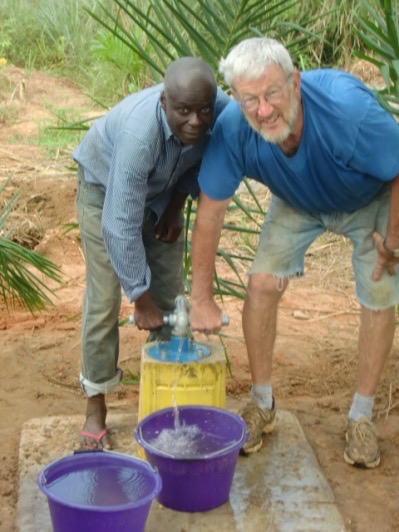
One way to change this situation is through access to well water. Clean water leads to better health, more opportunities, and therefore, a way out of poverty.

We have searched for a drill to meet this need in remote locations. We have found one such tool in
The Village Drill.

Benefits of The Village Drill:
• Utilizes local labor and resources since it is human-powered
• Can bore a 6 inch hole up to 250 feet deep
• Most economical drill available
• Provides pride and ownership for each community
• Provides access to safe drinking water
For more information about The Village Drill please click on this link: http://www.villagedrill.com

Safe drinking water has the power to change lives, reduce disease and begin the rise from poverty. Along with the gift of safe water we can share the story of Living Water as Jesus did when he spoke with the Woman at the Well.

To help meet the need for village wells, please consider giving to Hope for Congo. Let us be your hands and feet for the Congolese people.

Please send your tax-deductible U.S. Dollar donations to:
Africa Inter-Mennonite Mission (AIMM)
P.O. Box 744
Goshen, Indiana 46527-0744

Please send your tax-deductible Canadian Dollar donations to:
Africa Inter-Mennonite Mission (AIMM)
440 Main Street
Steinbach, MB R5G 1Z5

On your donation please indicate you wish your gift to be used to help Hope4Congo drill village wells.

© 2018 Hope4Congo

Kandale, Beauty for Ashes

To console those who mourn in Zion,
To give them beauty for ashes,
The oil of joy for mourning,
The garment of praise for the spirit of heaviness;
That they may be called trees of righteousness,
The planting of the Lord, that He may be glorified.”
~Isaiah 61:3 (NKJV)

Last week for our Christmas special, we posted three separate articles about Kandale. If you have not read the history of Kandale or if you would like to review it, you can use the following links to do so in order:
Part 1,
Part 2,
and Part 3

Now that you have read each of those posts, perhaps the healing that occurred this past October will have more meaning for you. Below is a re-post of Brad’s report originally posted on November 2, 2017:

_____________________________


KANDALE
A Story of Forgiveness, Reconciliation, and Restoration
by Brad Graber

The purpose of Hope for Congo’s trip to Kandale was to take part in an event needed to help the community overcome its history. Our interest in the community stems from our childhood connection to the mission station that was part of the Congo Inland Mission, now known as AIMM (Africa Inter-Mennonite Mission).

Originally known as the Kandala Mission Station, it was burned to the ground in 1964 by members of the Congolese-led Simba group. The Simba (Swahili for “Lion”) rebels were born of a new conflict against the four-year-old Congolese government.

The primary leader of the Simba rebels was a man named Pierre Mulele of the Bapende ethnic group. Mulele was an avowed Maoist and was supported by Communist China. Along with a Maoist political worldview the Simba incorporated aspects of their African worldview with its animistic beliefs and practices. They roamed in groups bringing terror, death, and destruction wherever they appeared.

Jeunesse, a French word meaning “youth,” was a common term used to refer to gangs of young men who were dissatisfied with how the official independence of 1960 failed to meet their demands. Their attacks were aimed predominately at government centers. However, mission stations were also attacked because of their close link to the government.

All of this activity became known as the Kwilu Rebellion. Some have referred to it as the “Second Independence,” suggesting it was an effort to correct some of the abuses and injustices that occurred in the four years following the official independence. Thus they viewed it as an effort to realize the original goals and dreams promised by what they termed the “First Independence.”

On a Tuesday evening in January 1964 the Simba rebels approached Kandale. First the gangs set the village on fire. Then they moved to the Kandala Mission Station. There they captured seven missionaries and two young missionary children, approximately seven years old. Next they burned the station to the ground and destroyed the missionary homes. Our parents and youngest sister were among the hostages.

The missionaries were held captive until a negotiated release obtained their freedom. The UN rescued them on Friday of the same week.

Kandala was not the only mission station attacked. The Kwilu Rebellion impacted both Protestant and Catholic missionaries. The most remembered hostage situation took place later in the city of Stanleyville. It included the death of missionary doctor Paul Carlson. His story is recorded in the book, Out of the Jaws of the Lion.

Ultimately the Kwilu Rebellion failed. However, it contributed to the ongoing chaos and instability that continues to challenge the people in Congo today. Mobutu eventually came to power and raped the country of its resources and potential.

The attack at Kandale resulted in a series of broken relationships within the community between those who participated locally in the events of that week and those who did not. Many struggled with a sense of guilt for not being able to stop the destruction of the mission station and capture of the missionaries. The community has been mired in a combination of those broken relationships and guilt for the past 54 years. All of this added up to a sense of there being a “curse” on them for their past.

Church members and church leadership initiated the desire for reconciliation. The entire community including the local chiefs and government officials embraced it. A Christian businessman became the lay leader of the movement.

God, in His timing, brought together a group of individuals from Congo and the United States to play a role in bringing about the needed forgiveness, reconciliation, and a new beginning of restoration for this community. Participants included the Kandale Church and community, the Mennonite Church of Congo, AIMM, Hope for Congo, and REVE Kandale.

A delegation of twenty people in five vehicles made the two-day trip from Kinshasa to Kandale. Others came on foot and via motorcycle. As we neared the site, a succession of painted rocks pointed the way and palm branches lined the road. A large group of people surrounded us as we entered the station. A palpable sense of excitement and anticipation rippled through the gathering.

The next day at 9:00 a.m. the delegation met with the local chiefs to communicate and acknowledge the past with an eye to the future. We were given symbols of a renewed relationship and a new beginning. This was followed by a large celebration at the church on the mission station from 11:00 a.m. until 5:00 p.m. (Congolese time).

The celebration included singing, dancing, and stories of God’s goodness and faithfulness. An estimated crowd of 1000 people inside and outside of the church building shared the joy of what God was doing in that moment.

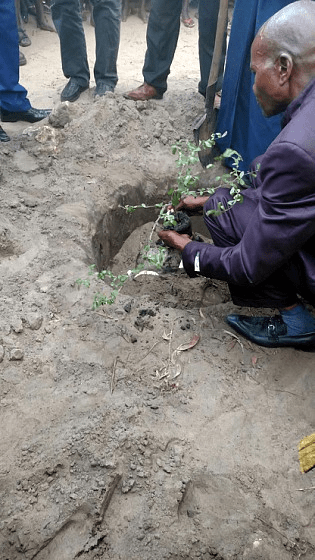
At the end of the celebration on Friday, a shade tree was planted in front of the church as a symbol of new life. It will be a memorial to the day’s events—a visible reminder that can be passed down to future generations.

Following the day of celebration we interacted with the community for two more days. Communion was served after the Sunday morning service to bring closure to our trip and to remind us all of our oneness as the family of God.

We left late Sunday afternoon and arrived back in Kinshasa at 3:00 a.m. Tuesday morning. Tired? Yes! But grateful and carried along by God’s presence each step of the way.

Poverty is a reality that is experienced by all on some level of their lives. I believe it begins with spiritual poverty, which leads to relational poverty, which in turn results in material poverty. The integration of all three can become so convoluted that it is difficult to separate one from the other. Such is the story of what happened in Kandale.

The Kandale story is not an isolated one. I have been told there are other places in Congo with a similar history and a similar need for forgiveness, reconciliation, and restoration. What makes this story unique is the miracle God unfolded. In a miraculous way He orchestrated the events leading up to the day of celebration. He answered the prayers of His children. It is now a story that revealed the heart of God and His desire for restoration. The grace of God reached down to lift people out of their broken relationships.

Hope for Congo’s goal is to provide tools and resources to our Congolese brothers and sisters, to provide them with the opportunity to participate in the process of lifting their communities out of poverty through the good news of the Gospel of Jesus Christ. Thus a shared lifting of assets can occur in each community to minister to both the body and the soul of each person.

Your prayers and donations to Hope for Congo are ways that you can actively participate with us and make an investment that has eternal impact. The Kandale story could be one among many stories of God at work in Congo.

How will you be part of those stories?

© 2017 Hope4Congo

______________________________

For Blog Roll, Click on this link and scroll to the bottom left

Prayer Requests:
• Praise God for the healing He sent to us through His Son, Jesus.
• Pray for the people of Kandale.
• Pray for our ministry, Hope4Congo to work effectively for Christ’s Kingdom.

© 2017 Hope4Congo

Why Jesus Came, Part 3

Forgiveness, Reconciliation & Restoration
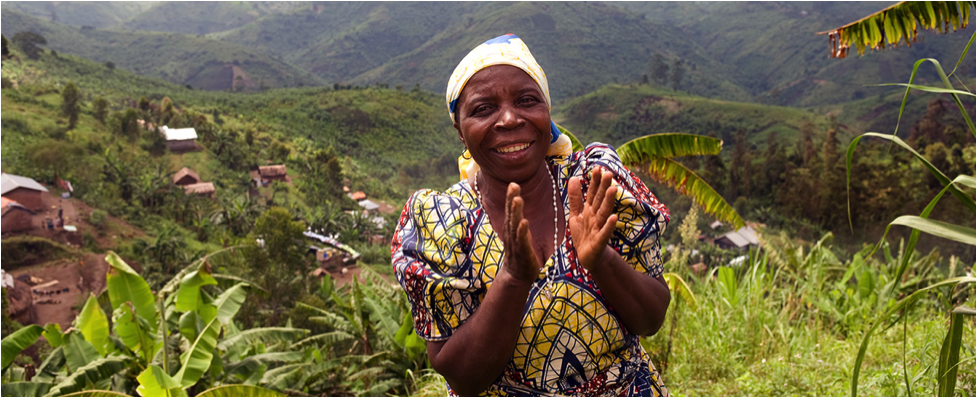
Behind this Joyous Woman Lies the Valley Across from Kandale

Today’s post is the last of a three-part series we’re running this week for our Christmas special. To re-read the previous posts or to read posts you may have missed, please click on Part 1 and/or Part 2 as needed.

When Brad and Stan visited Kandale in October they carried the following letter from their mother addressed to the people there. In the years since 1963-64 the spelling has changed from Kandala to Kandale. Although the spelling has changed, her love for those she served has not.

_______________________________

To the followers of Jesus at Kandala and my sisters and brothers in Christ:
May God’s mercy, love, and grace be your daily experience as you live to serve Him.

In God’s providence, my husband, Muambi Muoyila, my youngest daughter Jeannette, and I, Mama Mbuyi along with the Bertsches and Selma Unruh came to live at Kandala. It was 1963 and there was unrest in the area. This culminated in the destruction of buildings and the cessation of our ministry there in 1964. Our lives were threatened, but God miraculously spared us from what seemed certain death. God gave us His peace in the days that we were held captive.

During those days we experienced the love of God through the hands and feet of Christians who brought food to us, braving the wrath of our captors. They pleaded for our lives and they wept with us for gladness at finding that we were alive after a night of terror. The pastor took a severe beating as he tried to intercede for us.

The Bible Institute students who had come from all of the AIMM stations had to leave with their families and make the long trek back to their home villages. They and the local residents suffered greater loss than the missionaries who were taken out by helicopter.

As God alone can do, He turned this experience into blessing. We felt His comforting presence with us and He brought to our minds many scriptures that reassured us of His care. So through this experience my faith has grown. What is retained in my memory are the blessings we received from those who love and follow God. I am so grateful for their faithfulness and their courage during that difficult time.

My heart is filled with love for each one of you. How I wish I could express this to you personally. May the Spirit of God assure you today that we are one in Christ who offers forgiveness to each one of us.

“God is able to bless you abundantly so that in all things at all times, having all that you need, you will abound in every good work.” May this great promise from 2 Corinthians 9:8 bless and prosper you in your faith.

In fellowship always,
Gladys Graber (Mama Mbuyi)

___________________________

Mrs. Graber also sent this prayer with her sons: Words seem so inadequate to express what I’d like to convey! I hope your presence there will overcome this inadequacy as healing and love prevail.

____________________________

Amen and Praise the Lord, Mama Mbuyi! Your prayer was answered.

May you, our dear readers also find forgiveness and healing in your relationships so that the love of God may prevail in your hearts and lives this blessed Christmas. Christ came to restore broken relationships: first our relationship with God and second, the relationships we have with each other. Praise be to God for this greatest gift of Christmas!

© 2017 Hope4Congo

Why Jesus Came, Part 2

For our Christmas special this year we are reviewing the events that occurred in 1964 at the Kandala Mission Station. To read Part 1 in this three part series, please click here.

You might ask, why review those evil days? Because as we comprehend what was done, we see how deep the Father’s love for us truly is, how tremendous the forgiveness offered us through Jesus’ death and resurrection. We can appreciate His gift to us all the more. Without that gift, we would have no reason to celebrate Christmas.

The Kandala Mission Station was burned to the ground in 1964 by members of the Congolese-led Simba group. The Simba (Swahili for “Lion”) rebels were born of a new conflict against the four-year-old Congolese government.

Along with a communist political worldview, the Simba incorporated aspects of their African worldview with its animistic beliefs and practices. They roamed in groups bringing terror, death, and destruction wherever they went. During 1963-64 their attention was focused along the Kwilu River.

The following excerpt is taken from Jim Bertsche’s story in The Jesus Tribe: Grace stories from Congo’s Mennonites, 1912-2012 edited by Rod Hollinger-Janzen, Nancy Myers and Jim Bertsche. Photo above is also courtesy of Rod Hollinger-Janzen from the same book.

___________________________

The first warning Pastor Emmanuel Wayindama and his family had was the sound of excited shouting in the distance and the sight of shadowy figures leaping about, systematically setting fire to the thatch-covered homes of Bible Institute students.

Pastor Wayindama had been brought to Kandala in the fall of 1963 to serve on the teaching staff of the AIMM Bible Institute. An earlier graduate of the institute, he had demonstrated not only a keen mind but also a deep commitment to his Lord and to the church. When the search was on for Congolese to join the teaching staff at Kandala, Pastor Emmanuel Wayindama was an early choice.

The institute had been displaced from Tshikapa on the banks of the Kasai River some 100 miles to the east because of the tribal conflict that had erupted there after the hastily granted independence in 1960. Unfortunately, the move placed the institute in a territory where a different kind of unrest was brewing, in which missions were often a target.

On this violent night in January 1964 all along the Kwilu River both Catholic and Protestant mission posts were attacked. In the rebels’ view, missions had partnered with the hated Belgians and needed to be eliminated before the country could be reconstructed for the good of all.

The young rebels declared, “We need to remove all traces of what was before so Moscow will come and help us rebuild our country.”

As rebels arrived at the small thatch-covered home of Pastor Wayindama, his wife and family managed to escape into the surrounding darkness but the pastor was intercepted.

“And who are you?” they asked him. “Are you also part of this school of foreigners that the missionaries brought here to Kandala?”

“Yes, I am a teacher at the Institute.”

“So you are not a student?” (Pastor Wayindama was a small man.) “Are you then a pastor?”

“Yes I am.”

“A pastor! That’s even worse.”

From that point on the interrogation was accompanied by a hail of blows, some with fists, some with the arrows and wooden arcs of the bows carried by each rebel. Pastor Wayindama was soon bloodied and beaten to his knees.

Then the rebel team leader leaned over and shouted into his face: “You know that I can kill you right here on this spot, don’t you?”

Pastor Wayindama looked into the eyes of his tormentor and through bloody, swollen lips replied: “Sure you can, but if you do, that’s all you can do to me!”

The rebel leader was speechless. He had fully expected to see the pastor grovel at his feet pleading for his life. For a long moment he stared at him, then turned and ordered his team elsewhere.

Pastor Wayindama lived to lead student families to safety across some 125 miles of dry, hot landscape, limping painfully all the way. His experience and witness are part of the precious legacy of the Mennonite Church of Congo.

_______________________________

Through Pastor Wayindama’s paraphrase above, “…That’s all you can do to me!” I hear the echo of Jesus instruction to us:

“I tell you, my friends, do not be afraid of those who kill the body and after that can do no more.”
Luke 12:4 (NIV)

For further study see also Matthew 10:28

God’s Word has power to convict hearts. Praise God it convicted the heart of a young man bent on terror. Can you imagine the heartache he would have experienced one day if he had murdered that dear man of God? The terror he intended would have come back to torment his own soul.

We have one more part of this story to share. Join us this Friday for Part 3 of this series. To review Part 1 click here.

© 2017 Hope4Congo

How Deep the Father’s Love For Us as sung by Fernando Ortega
https://www.youtube.com/watch?v=dLDGVl8D5UU