We’re glad you joined us today for Part 2 of the recent activity at Mangungu carried out by David, Bud, Nelson, and Mark. This letter was written by Clement (Bud) Kroeker. Read Part 1 of Bud’s letter at this link.
Part 2
It was quite a challenge for David to organize the various crews of workers–the men from Matende as well as the volunteers from Mangungu. He gave responsibilities to some of the men who worked with him the past three trips and let them supervise the different construction sites. But he faced the problem of having too many volunteers, not enough tools, and not enough supervisors. So we decided to use one group to work on the stone house and another in the Health Center.
Three ladders (built on previous trips) came with us on the truck. Two others needed to be built plus the scaffolding. A crew of young men started digging the cistern for water. Another crew started digging a hole for the septic tank.
The shovels (made in China) that we had purchased in Kikwit were not sturdy enough and soon the handles were breaking one by one. But in true Congolese fashion, the men would quickly replace the handles with sturdy wooden branches or poles they cut down with their machetes to fit.
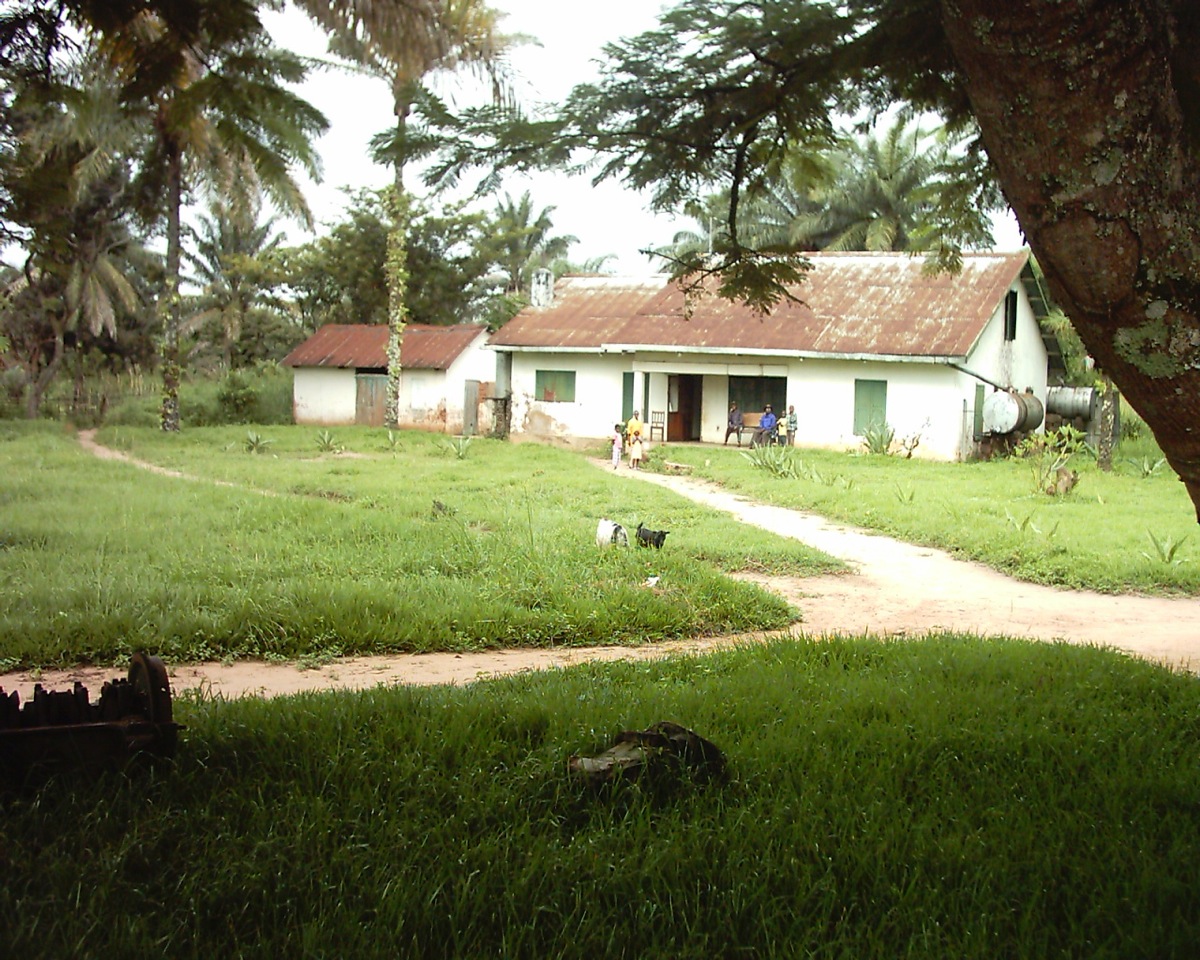
The electrical generator was installed under the huge mango tree and this was the wood-working shop. I found an old piece of concrete broken off of an ancient bath tub made by some missionary sixty years ago. This served as a chair for me. It became my director’s office. However, I didn’t spend much time there because bits of stone and concrete flew in every direction as the young men tried to straighten up the old walls and pour concrete on top of the door posts and windows to give added strength.
Nelson brought up sand from a spot near the river. It was very hard to drive down there with the truck in order to bring water. So we asked the children to each haul a quart of water on their heads when they come up in the morning. Gravel will probably have to be hauled up in the same way by the older fellows.
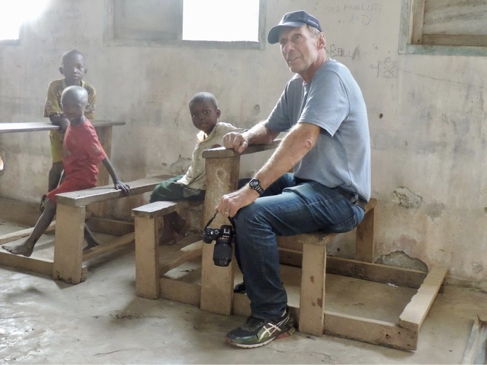
Mark with children at Matende
After the first day’s work we already saw the progress made: two huge holes dug, each around 6 feet in depth; half of the old tin roofing panels were taken off the Health Center and the walls were strengthened with concrete in the cracks, after putting in solid iron bars.
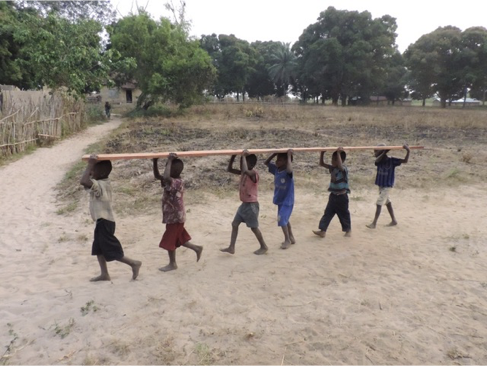
In the evening a parade passed by our house, everyone carried a board to take the entire stack of boards over to the school area where they would be protected. The big men each carried one board, the younger men each took one end of a board, and the children (sometimes as many as six under one board), carried it on their heads!
I had only a limited stock of Bibles with me on this trip, 50 in French and 50 in Kikongo — but I gave one copy to each pastor in the villages surrounding Mangungu. Everyone gathered under the mango tree for a meeting of gratitude, to sing and pray and express their thanks to God.
Our hearts were blessed to be able to live these moments of true worship and praise. If we didn’t accomplish anything else on this trip, it was worth the time and effort spent, just to have been in that meeting with others of God’s children!
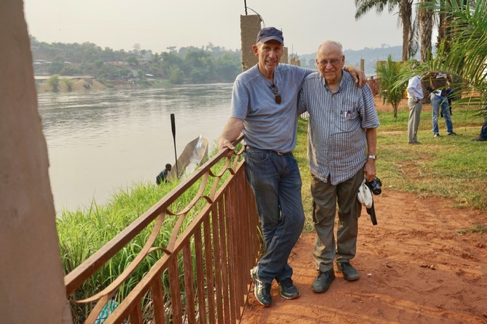
Kikwit by the Kwilu River
Psalm 67 May God be gracious to us, and bless us
and make his face shine upon us; so that your ways may be known on earth,
your salvation among all nations. May the peoples praise you, O God;
may all the peoples praise you. May the nations be glad and sing for joy…
(verses 1 – 4)
With grateful hearts for your prayers for us in Congo,
Bud, Mark, David and Nelson
_________________________
What a joy it is to see the Congolese teamwork to accomplish a goal for the common good. If you wish to know more about Clement (Bud) Kroeker’s work visit his website: http://congoopenheart.org/projects/
We’re telling the story of the missionary couple, David and Svea Flood. The story is adapted from their daughter, Aggie Hurst’s personal account, but the story is really about so much more than their little family. Today we begin Part 4. If you missed earlier portions of the story, you can find them here: Part 1, Part 2, andPart 3.
One Seed Part 4
A few years later, the Hursts were attending a high-level evangelism conference in London, England, where a report was given from the nation of Zaire (the former Belgian Congo). The superintendent of the national church, representing some 110,000 baptized believers, spoke eloquently of the gospel’s spread in his nation.
Aggie could not help going up afterward to ask him if he had ever heard of David and Svea Flood. “I am their daughter.”
The man began to weep. “Yes, madam,” he replied in French, his words were translated into English. “It was Svea Flood who led me to Jesus Christ. I was the boy who brought food to your parents before you were born. In fact, to this day your mother’s grave and her memory are honored by all of us.”
Sobbing, he embraced her in a long hug before he continued. “You must come to Africa to see, because your mother is the most famous person in our history.”
In time that is exactly what Aggie Hurst and her husband did. They were welcomed by cheering throngs of villagers. She even met the man who so many years before, when she was less than a month old, had been hired by her father to carry her down the mountain in a soft bark hammock.
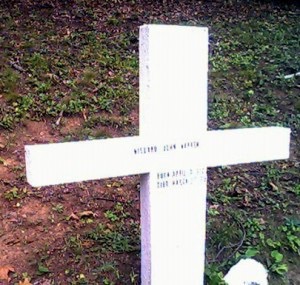
Of course, the most dramatic moment came when the pastor escorted Aggie to see her mother’s grave. She knelt before the white cross in the soil of Africa—the place of her birth—to pray and give thanks.
In the church service later that day, the pastor read from John 12:24… “I tell you the truth, unless a kernel of wheat falls to the ground and dies, it remains only a single seed. But if it dies, it produces many seeds.”
He followed with Psalm 126:5, “They who sow in tears shall reap in joy.”
So, that’s the conclusion to this 4-part story of the One Seed.
It took forty years before God’s amazing grace and His real plan for the village of N’dolera was known to Aggie Hurst and then to her father. It seemed all was lost, but God wasn’t done working.
When we are in deep discouragement, we need to remember the story’s not over yet. One chapter may have ended, but God is still at work.
If that’s what one seed can do, isn’t it amazing to think about all those other seeds that have been planted over the years?
The story of God’s sovereign work is not over. He’s still planting seeds. He’s still growing believers.
Click here toFOLLOW US. Fill out your email information on the right hand side of the page that opens. Our posts will be delivered directly to your email inbox.
Prayer Requests: *Please continue to pray for the political situation in the DRC. *Pray for nearly 50,000 Christians who have been displaced by Islamic militants in the North Kivu province.
We’re telling the story of the missionary couple, David and Svea Flood. The story is adapted from their daughter, Aggie Hurst’s personal account, but the story is really about so much more than their little family. Today we begin Part 3. If you missed earlier portions of the story, you can find them here:Part 1andPart 2.
One Seed Part 3
For Rev. Dewey and Aggie Hurst’s twenty-fifth wedding anniversary (in the 1960s), the college presented them with the gift of a vacation to Sweden. There Aggie met her biological father. An old man now, David Flood had remarried, fathered four more children, and generally dissipated his life with alcohol. He had recently suffered a stroke. Still bitter, he had one rule in his family: “Never mention the name of God because God took everything from me.”
After an emotional reunion with her half brothers and half sister, Aggie brought up the subject of seeing her father. Her siblings hesitated. “You can talk to him,” they replied, “even though he’s very ill now. But you need to know that whenever he hears the name of God, he flies into a rage.”
Aggie would not be deterred.
When she entered her father’s squalid apartment, she found it littered with liquor bottles everywhere. Her seventy-three-year-old father lay in his rumpled bed.
“Papa?” Aggie said tentatively.
He turned and began to cry. “Aina,” he said, “I never meant to give you away.”
“It’s all right Papa.” She took him gently in her arms. “God took care of me.”
The man instantly stiffened. The tears stopped.
“God forgot all of us. Our lives have been like this because of Him.” He turned his face to the wall.
Aggie stroked his cheek and continued, undaunted. “Papa, I’ve got a little story to tell you, and it’s a true one. You didn’t go to Africa in vain. Mama didn’t die in vain.
“The little boy you both won to the Lord grew up to win that whole village to Jesus Christ. The one seed you planted just kept growing and growing. Today (about 1964) there are six hundred African people serving the Lord because you and Momma were faithful to the call of God on your life.
“Papa, Jesus loves you. He has never hated you.”
The old man looked into his daughter’s eyes. His body relaxed and he began to talk. By the end of the afternoon, he had come back to the God he had resented for so many decades.
Over the next few days, father and daughter enjoyed warm moments together. Soon Aggie and her husband had to return to America. A few weeks later, David Flood entered eternity.
End of Part 3, but the story’s still not over.
Join us next week for Part 4 of the Floods’ story. So you don’t miss out, click onFOLLOW US. In the page that opens, fill out your email information on the right hand side of the page. Our posts will be delivered directly to your email inbox.
Today we continue the story of the young missionary couple, David and Svea Flood. They left their home in Sweden to minister in what at the time was Belgian Congo. The year was 1921. Things were primitive and discouraging for them. Svea died after giving birth to a baby girl. David blamed God for ruining his life. He left the baby girl in the care of the Ericksons (another missionary couple ministering in Congo) and returned to Sweden. Click here to readPart 1.
________________________________________________________________________________ No matter how dark things get, we need to remember God’s not finished yet. David and Svea Flood’s story is adapted from their daughter Aggie’s personal account.
One Seed
Part 2
Within eight months both the Ericksons were stricken with a mysterious illness. Some believe they were poisoned by a local chief who hated the missionaries. The couple died within days of each other.
The nine-month-old baby Aina was given to an American missionary couple named Berg, who adjusted her Swedish name to “Aggie” and eventually brought her back to the United States at age three.
The Bergs loved little Aggie. They were afraid if they tried to return to Africa, some legal obstacle might separate her from them. At that time, they’d been unable to legally adopt her. So they decided to stay in the United States and switch from missionary work to pastoral ministry.
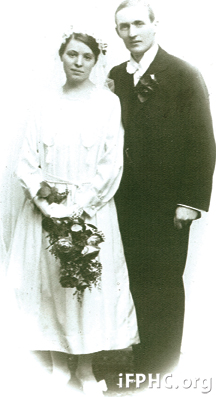
Aggie grew up in South Dakota. As a young woman, she attended North Central Bible college in Minneapolis. There she met and married a young preacher named Dewey Hurst.
Years passed. The Hursts enjoyed a fruitful ministry. Aggie gave birth first to a daughter, then a son. In time her husband became president of a Christian college in the Seattle area, and Aggie was intrigued to find so much Scandinavian heritage there.
One day around 1963, a Swedish religious magazine appeared in her mailbox. She had no idea who sent it, and of course she couldn’t read the words. But as she turned the pages, all of a sudden a photo stopped her cold. There in a primitive setting in the heart of Africa was a grave with a white cross and on the cross was her mother’s name, SVEA FLOOD.
Aggie jumped in her car and drove straight to a college faculty member who, she knew, could translate the article. “What does this say?” she asked.
The instructor translated the story: It tells about missionaries who went to N’dolera in the heart of the Belgian Congo in 1921… the birth of a white baby girl… the death of the young missionary mother… the one little African boy who had been led to Christ… and how, after all the whites had left, the little African boy grew up and persuaded the chief to let him build a school in the village.
The article told how this now grown man gradually won all his students to Christ… the children led their parents to Christ… even the chief had become a Christian. Today (1963) there were six hundred Christian believers in that one village.
Because of the willingness of David and Svea Flood to answer God’s call to Africa, because they endured so much but were still faithful to witness and lead one little boy to trust Jesus, God had saved six hundred people.
That little boy, as a grown man, became head of the Pentacostal Church and leader of 110,000 Christians in Zaire (formerly the Belgian Congo).
At the time Svea Flood died, it appeared, to human reason, that God had led the young couple to Africa, only to desert them in their time of deepest need.
But that wasn’t the end of the story. It’s only the end of Part 2.
Join us next week for Part 3 of the Floods’ story. So you don’t miss out, click onFOLLOW US. In the page that opens, fill out your email information on the right hand side of the page. Our posts will be delivered directly to your email inbox.
We are more than conquerors. The powers of hell can never separate us from God’s love. The story of David and Svea Flood, missionaries to the Belgian Congo, illustrates this truth of God’s faithfulness and unfailing love even during the darkest hours.
God begins a work, bringing life and light to people and nations. His light grows ever brighter over time despite human events and Satan’s efforts to thwart God’s work.
At times as you read this 4-part story of the Flood family, it may seem as if the light is gone, but be encouraged. The story’s not over yet. ________________________________________________________________________________ David and Svea Flood’s story is adapted from their daughter Aggie’s personal account.
One Seed Part 1
In 1921, a missionary couple named David and Svea Flood went with their two-year-old son David, from Sweden to the heart of Africa—to what was then called the Belgian Congo. They met up with another young Scandinavian couple, the Ericksons, and the four of them sought God for direction. In those days of much tenderness and devotion and sacrifice, they felt led by the Lord to go out from the main mission station and take the gospel to a remote area.
This was a huge step of faith. At the isolated village of N’dolera they were rebuffed by the chief, who would not let them enter his village for fear of alienating the local gods. The two couples opted to go half a mile up the slope and build their own mud huts.
They prayed for a spiritual breakthrough, but there was none. Their only contact with the villagerswas a young boy, who was allowed to sell them chickens and eggs twice a week. Svea Flood—a tiny woman, only four feet, eight inches tall, decided that if this was the only African she could talk to, she would try to lead the boy to Jesus. And in fact, after many weeks of loving and witnessing to him, he trusted Christ as his Savior.
But there were no other encouragements.
Malaria struck one member of the little band after another. In time, the Ericksons decided they’d had enough suffering and left to return to the central mission station. David and Svea Flood remained near N’dolera to go on alone.
Then, in the middle of that primitive wilderness, Svea became pregnant. When the time came for her to give birth (1923), the village chief softened enough to allow a midwife to help her. A little girl was born, whom they named Aina (A-ee-nah).
The delivery exhausted Svea. She was already weak from bouts of malaria. The birth process was a heavy blow to her weakened stamina. After seventeen desperate days of prayer and struggle, she died.
Inside David Flood, something snapped. His heart full of bitterness, he dug a crude grave, buried his twenty-seven-year-old wife and took his children back down the mountain to the mission station.
Giving his newborn daughter to the Ericksons, he said, “I’m going back to Sweden. I’ve lost my wife, and I can’t take care of this baby. God has ruined my life.” With two-year-old David, he headed for the coast, rejecting not only his calling, but God himself.
End of Part 1, but the story isn’t over.
Join us next week for Part 2 of the Floods’ story. So you don’t miss out, click on FOLLOW US. In the page that opens, fill out your email information on the right hand side of the page. Our posts will be delivered directly to your email inbox.
Praise Report & Prayer Requests • Charles Buller thanks all of you who held he and his team in your hearts during the most recent Congo Leadership Support seminars in Congo (September 25 – October 7). He said, “I believe the Spirit met all of us—presenters and participants alike—in profound ways that certainly exceeded my expectations. 250+ brothers and sisters joined us for these transformative events—many who walked well over 100 kilometers to do so. Please pray a blessing over these dear souls.” • Continue to pray for the political situation in Congo.
GUEST POST
Today we complete the Guest Post by Matthew Harder. Click these individual links if you would like to read Part 1 and/or Part 2of Matt’s story.
From the Bush to the Bush, Part 3 by Matthew Harder
I sat on an ice chest in the cockpit of an old Russian Antonov airplane because the rest of the plane had been overbooked with people and cargo. It was literally standing room only.
Right before take off people pounded on the cockpit door and shouted, “The door is open.”
I tapped the co-pilot on the shoulder to alert him. He stopped the airplane and closed the door. Somehow we managed to arrive safely.
The usual difficulties of travel in Congo confronted me. I spent a day obtaining obscure permits and licenses to travel from Tshikapa to Nyanga (these additional regulations were mostly due to the diamond mines).
The next leg of my trip was overland on a motorcycle. Two flat tires necessitated the use of locally produced glue to patch the tubes. We crossed a river using carved out tree logs.
A blown out piston required my driver and I to walk through the bush in the dark looking for another mode of transport. We ran into an angry policeman who accused me of being amercenary. My driver venomously insulted the policeman’s tribe to the extent he was nearly thrown in jail.
I found someone with a motorcycle and bargained with him to take me to Nyanga. The policeman saw me negotiating around a campfire at 10:00 p.m. and became irate once again.
Matt’s Nyanga home, a shell of its former appearance
Finally, I arrived at Nyanga at 11:00 p.m. I had never notified anyone I was coming. I found a house with a light on. Men who had worked with my dad on the SEDA farm sat outside. Their surprise at my arrival quickly changed to the warmest welcome I have ever experienced.
During my visit to Nyanga stories relegated to the distant past—long forgotten experiences that seemed to balance in the realm of myth now were validated reality. Our house, the farm, the village, and the people opened a floodgate of memories. It was all true. I was even able to understand and speak Kipende again.
When my visit was over I was able to put away the rich memories of this experience into a secure vault. We returned to Tshikapa by a different route to avoid the insulted policeman.
For a while my desire to return and/or to travel had been more from nostalgia or running away. I was restless and unsure what I wanted out of life. However, the Lord used those positive experiences I had growing up in Congo—the exposure and the adventures—to greatly influence me. I had seen a world that lived with far less.
The Drive that Pushed Me to Go Overseas was Two-fold: 1. A Christ-influenced desire to make a difference and help those less fortunate 2. To Pursue a life where I could choose my own adventure
During my first year on the job back in the bush, the bush of war-torn South Sudan, the restlessness molded into a sense of belonging to an international life, one that chased challenging professional growth while making the world a better place.
I have just spent the past four years working in South Sudan (most of the time being spent in country) and am now transitioning, once again, to a new job, this time in Saudi Arabia.
Often times the path to get to where you want to go is not straight, but instead ventures through years of preparation and self-discovery. ___________________________________________________________________________ Well said, Matt.
Thank you for putting your experiences and emotions into words. God obviously had a purpose for all that restlessness. Indeed, He has a purpose for restlessness in each of us.
You have made us for Yourself (God) and our hearts are restless until they can find rest in You. ~St. Augustine (354-430 A.D.)
Congo in the News
The U.S. State Department has ordered family members of government personnel to leave the Democratic Republic of Congo because of continued instability. In recent weeks tehre have been violent street protests against the postponement of presidential elections. At least 50 people have been killed in clashes between demonstrators and the security forces in the capital, Kinshasa. The east of hte country remains lawless, with the government unable to exert much authority outside urban areas.
Prayer Requests *Please continue to pray for the political situation in Congo.
When the state deparment order was posted a former missionary noted, “Wow, 25 years almost exactly to the day from when many of us left before, with great hopes certainly that things would be better by now, surely. *Pray for the safety and ministry of Charles Buller and his partners

 Hope 4 Congo
You must be logged in to post a comment.